Grid Prep Start free

For the NERC System Operator Certification exams

Study to the cut score.

1,224 original questions for the RC, BT, TO and BI exams. Mock exams and your readiness figure follow the weights in your exam's published content outline. Where you stand shows as a projected score against the cut: 92 of 120, or 76 of 100. Never a percentage.

50 questions and a 30-question timed taster, free. No account.

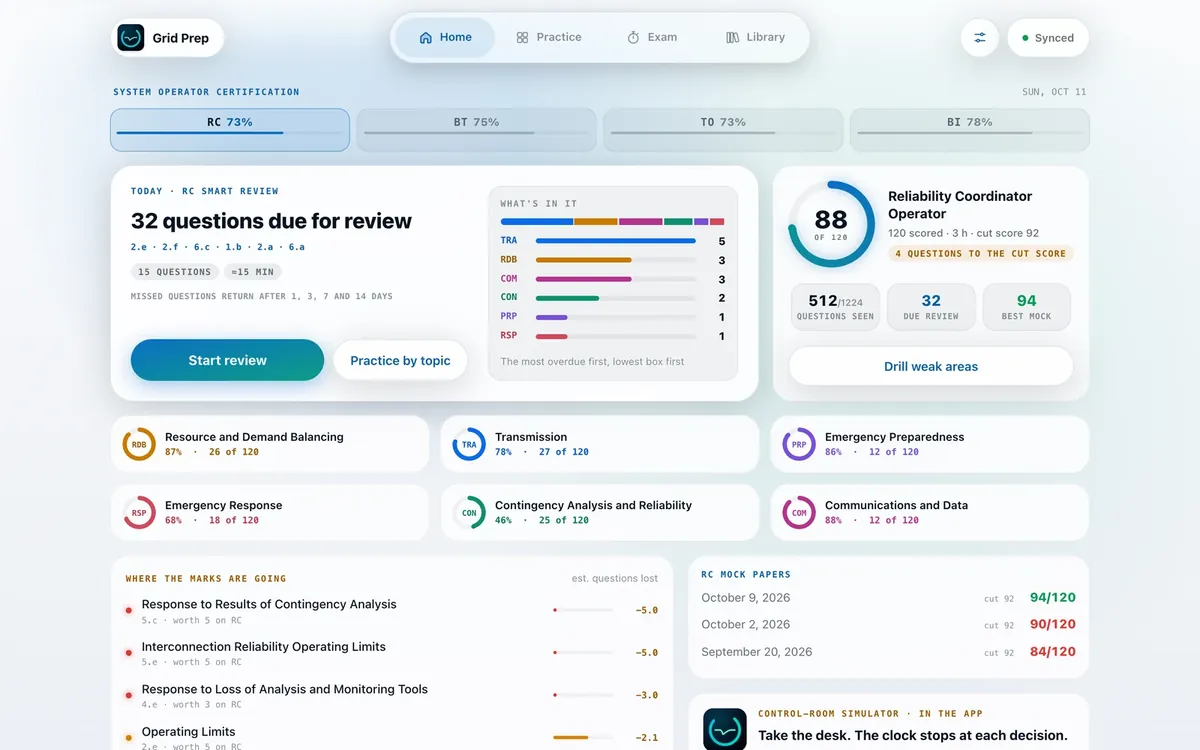
Grid Prep in a browser: the Home screen with a readiness ring at 88 of 120, four questions to the cut score, and 32 questions due for review
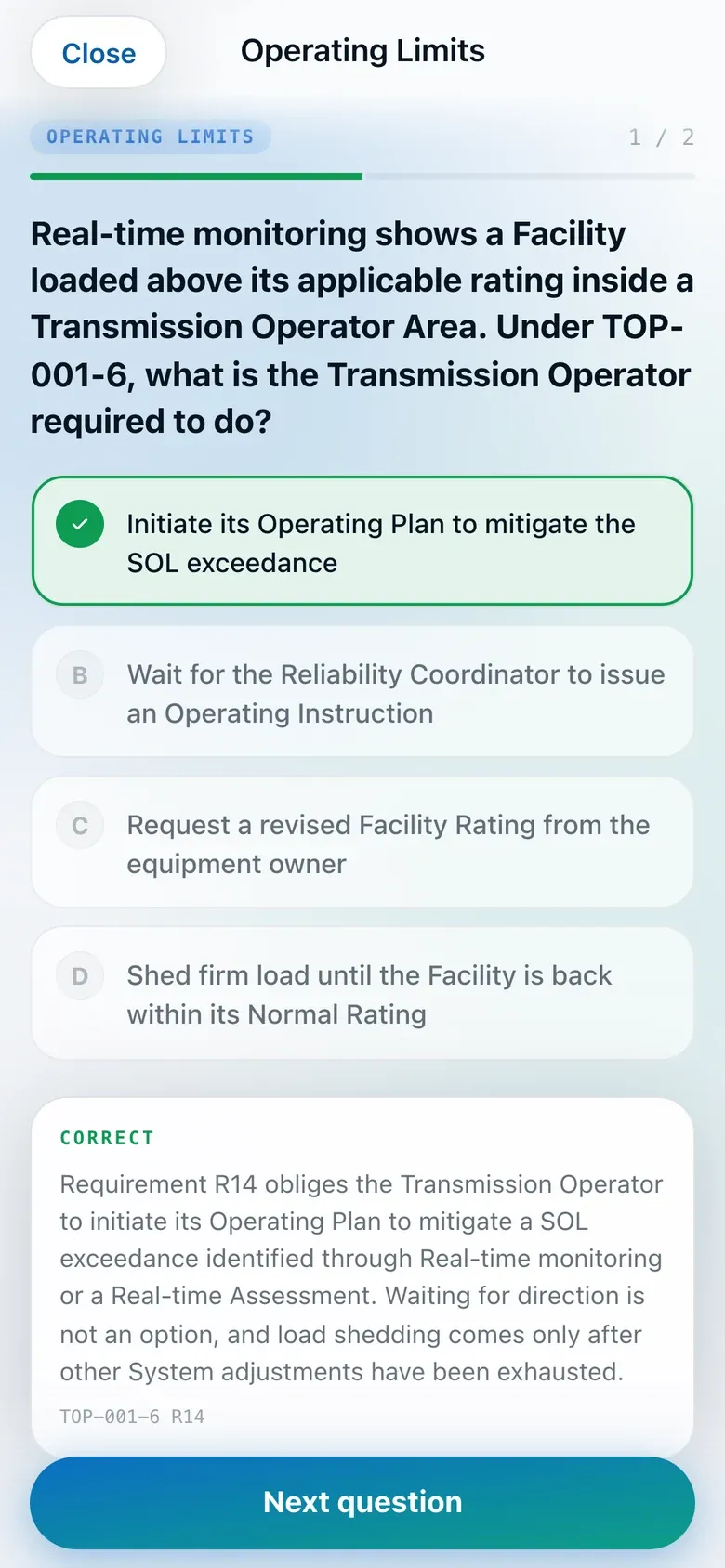
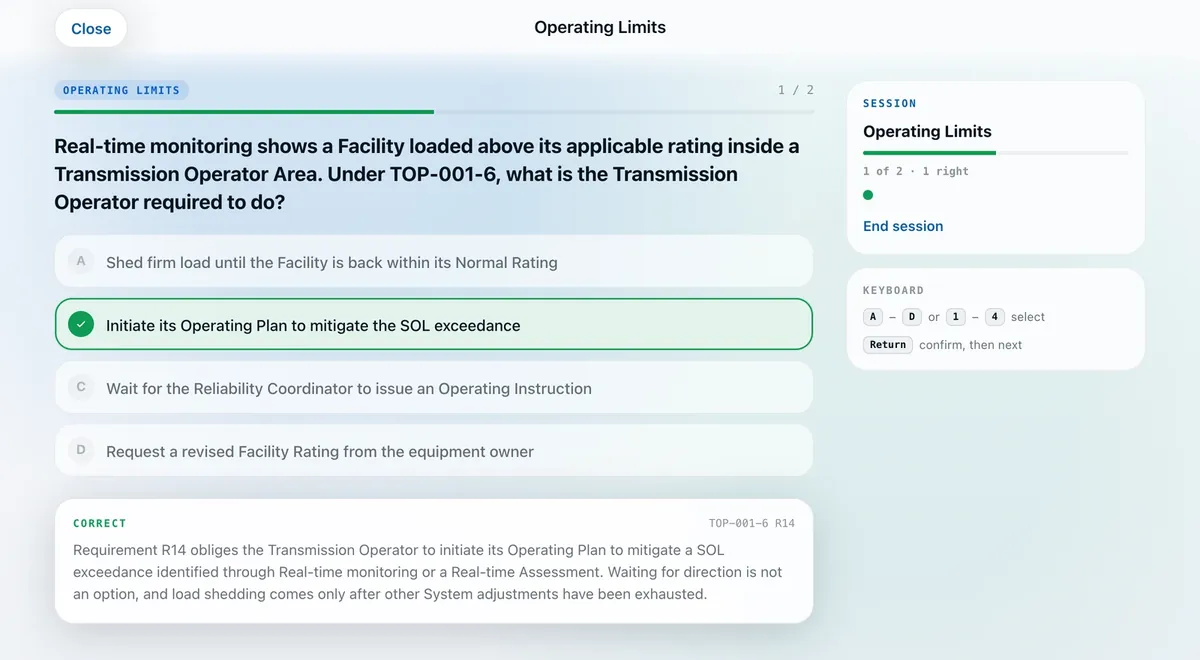
Grid Prep on a phone: a practice question answered correctly, with its explanation and the reference TOP-001-6 R14

The exam

How the exam works

  • 4 credentials RC, BT, TO and BI. Every paper draws on the same six domains and 31 knowledge areas. Only the number of questions per area changes.
  • 140 / 120 questions 120 scored on RC and BT, 100 on TO and BI. Plus 20 experimental questions that don't count, and you aren't told which.
  • 3 h on the clock Computer-based, multiple choice, at a Pearson VUE testing center. About 77 seconds a question on RC and BT.
  • 92 / 76 cut score Correct answers needed: 92 of the 120 scored, or 76 of the 100. A count, not a percentage.
  • 42 days after a fail The wait before you can sit any of the four exams again. Each $700 registration covers one sitting.
  • 3 years per certificate Then renewal: 200 CEHs for RC, 160 for BT, 140 for TO and BI.

From the System Operator Certification Program Manual (V4.2), the four content outlines (June 2023), the Exam Resource Materials (January 2025) and the fee schedule, as posted on nerc.com in October 2026.

In the bank

One bank, four credentials

Pick your credential and everything re-weights to that paper's outline: the readiness figure, the weak-area list, the mock exam. Every answer you give counts toward all four.

  • 1,224 original questions. 30 to 45 in each of the 31 knowledge areas. Each one comes with an explanation and the source it rests on: the standard and requirement, the Glossary term, or the operating principle.
  • Three cognitive levels, as NERC defines them. Every question is tagged recall, application or analysis, the three levels in NERC's exam resource materials: 483, 497 and 244 of them.
  • Mock exams at exam pace. The whole paper, as on exam day: 140 questions on RC and BT, 120 on TO and BI, in three hours. The scored ones follow the outline area by area, and 20 unscored questions are mixed in. Flag and come back, no feedback until you submit, auto-submit at zero. Then a review of every question with its source.
  • A projected score, not a percentage. Readiness reads like "84 of 120 · 8 to the cut score".
  • Where the marks are going. The knowledge areas costing you the most scored questions, ranked, each one a tap from a practice set.
  • Smart Review. A miss comes back the same day. Questions you keep getting right come back further apart.
  • Practice sets. Blueprint Sprint (20 at the paper's weighting), Weak-Area Drill (15), Missed, Unseen, or any one knowledge area, 12 at a time.
  • The Library. 31 cards, one per knowledge area: seven must-know numbers each, and a short note.
  • 483Recall
  • 497Application
  • 244Analysis
The 1,224 questions by cognitive level
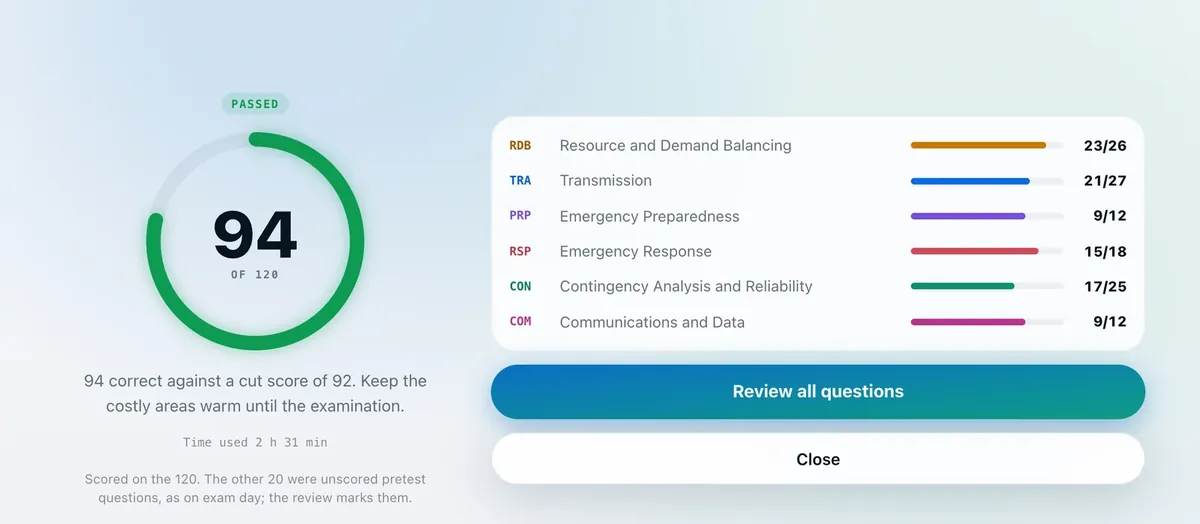
A finished mock exam in Grid Prep: 94 correct out of 120, passed against a cut score of 92, with the score for each domain and a note that 20 unscored questions were mixed in
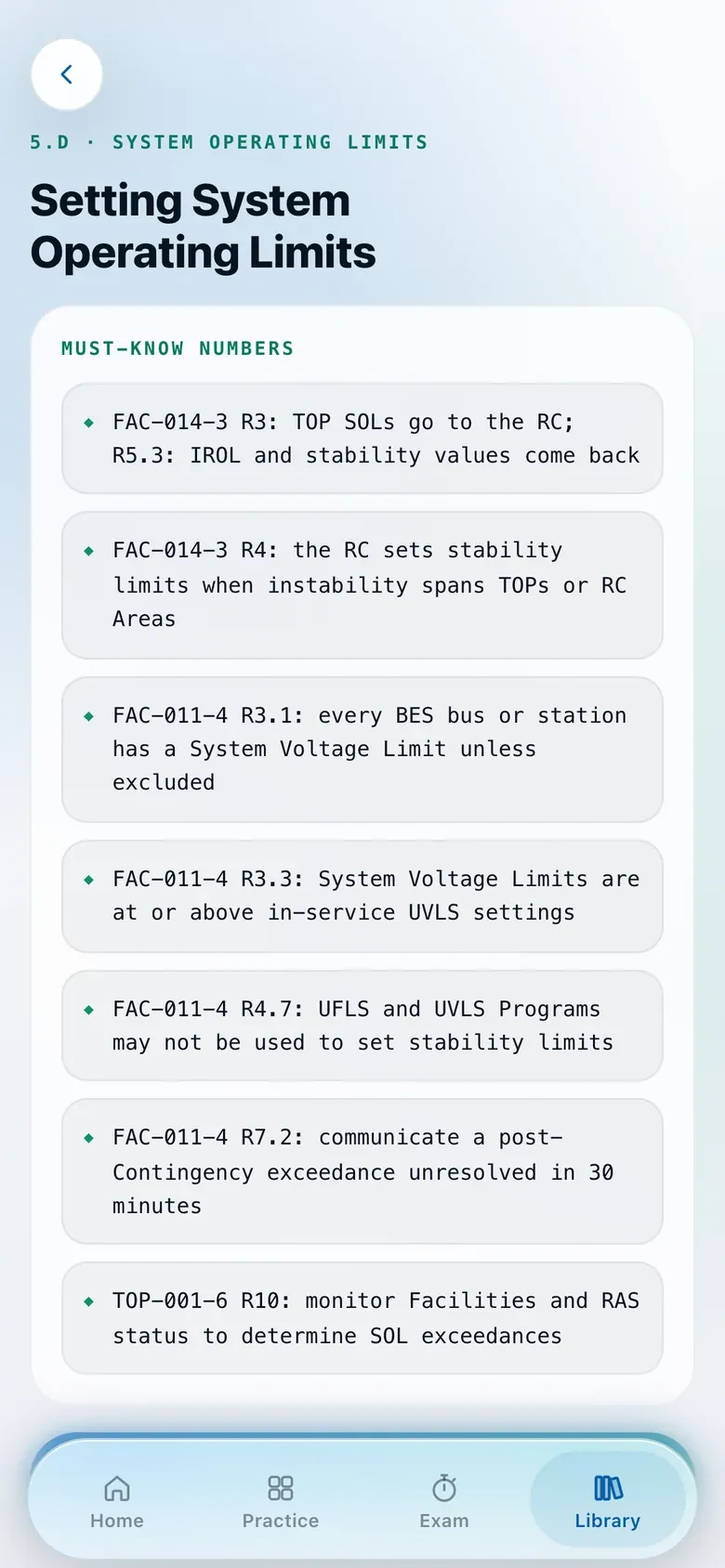
A Library card in Grid Prep for 5.d System Operating Limits: seven must-know requirements from FAC-014-3, FAC-011-4 and TOP-001-6
A finished exam-pace paper, scored on the 120, and a Library card on a phone. Screens from the web app.

A–D or 1–4 to answer, Return to confirm. Light, dark or automatic.

Try one

A sample question

Question 1 · Analysis2.e Operating Limits

A Transmission Operator's own study gives a 725 MW limit for a path, while its Reliability Coordinator's established limit for the same path is 685 MW. How should the Transmission Operator operate the path?

  1. A. To 725 MW, the value produced by the Transmission Operator's study
  2. B. To 705 MW, the average of the two established values
  3. C. To 725 MW, pending confirmation from the Reliability Coordinator
  4. D. To 685 MW, the more limiting of the two established values
Show the answer

Answer D To 685 MW, the more limiting of the two established values

TOP-001-6 Requirement R18 directs the Transmission Operator to operate to the most limiting parameter where there is a difference in SOLs, which here is 685 MW. Averaging the two numbers gives 705 MW and has no basis in the standard, and operating to the looser value while waiting for confirmation leaves the System above the governing limit.

Reference: TOP-001-6 R18
No black box

How readiness and Smart Review work

Every figure on the Home screen comes from your answers and the published outline. This is the arithmetic.

Readiness: a projected score against the cut

  1. Per question. Each question you've answered scores between 0 and 1. Your last answer is three quarters of it. Your record on that question is the other quarter. Right last time after two misses: 0.75 + 0.25 × ⅓ = 0.83.
  2. Per knowledge area. The average over the questions you've answered there, held down while the sample is small, as if three more answers at one half were in the mix. Two right from two reads 0.70. Ten from ten reads 0.88. An area you haven't opened reads zero.
  3. Per paper. The area scores are weighted by how many scored questions each area carries on your credential, then multiplied by the paper length. That's the projected score, shown beside the cut: "84 of 120 · 8 to the cut score". It is an estimate from your practice answers, not a prediction of your exam result.

The percentages on the credential chips and domain rings measure progress. The pass line is always a count.

Where the marks are going

Each knowledge area's estimated loss is (1 − area score) × the questions it carries on your credential. Area Control Error is worth 4 on BI and 1 on TO, so the same area score of 0.5 costs a BI candidate 2.0 questions and a TO candidate 0.5.

The list is ranked by that loss. A 5-question area at 0.6 (−2.0) sits above a 1-question area you've never opened (−1.0).

Smart Review

Every question you've answered sits in one of five boxes:

Since your last missDue again
You just missed itSame day
Right onceIn 1 day
Right twice in a rowIn 3 days
Right three times in a rowIn 7 days
Right four or more times in a rowEvery 14 days

A Smart Review set is up to 15 questions. Everything due comes first, lowest box and longest overdue at the front, then the set is topped up from your six weakest areas. Mock-exam answers feed the same schedule. The schedule follows you across browsers on your license key, or across devices through iCloud in the app.

Two ways in

Browser or app

The same 1,224 questions and the same scoring in both. The app adds the trainers that need a screen of their own. They are separate purchases.

WebiPhone, iPad and Mac app
Runs onAny modern browser: a work PC, a Mac, a Chromebook, a phoneiPhone, iPad and Mac, from the App Store
QuestionsAll 1,224All 1,224
Mock examsThe full paper at exam pace: 140 or 120 questions in 3 hours, 20 of them unscoredTimed, 3 hours, sampled to the outline
Readiness, Smart ReviewYesYes
Library (31 cards)With Full AccessFree
Generated one-line with an N-1 contingency report—Yes
AGC control board, ACE left for you to work out—Yes
20 worked calculation drills—Yes
Control-Room Simulator, nine scenarios—Yes
Progress syncAcross up to five browsers on one license keyThrough your own iCloud
OfflineNo, it needs a connectionYes
Free to start50 practice answers and a 30-question timed taster50 practice questions, one full mock exam, one simulator run, the whole Library
Full AccessUS$24.99 once, license key by emailOne in-app purchase, one time

A web license doesn't unlock the app, and the in-app purchase doesn't unlock the web.

Pricing

Pay once

In your browser

Web

US$24.99one time

  • Every question, unlimited mock exams at exam pace on all four credentials, Smart Review and the Library.
  • License key by email. No account, no subscription.
  • Use it on up to five browsers, with your progress synced between them.
  • Free first: 50 practice answers and a 30-question timed taster.
Start free in your browser Web checkout opens soon

iPhone, iPad and Mac

App

Freedownload

  • Free: 50 practice questions, one full mock exam, one simulator run and the whole Library.
  • Full Access is one in-app purchase. One time, no subscription.
  • Adds the Control-Room Simulator, the generated one-line and AGC board, and 20 calculation drills.
  • Works offline. Syncs through your iCloud.
Download on the App Store

A web license doesn't unlock the app, and the in-app purchase doesn't unlock the web.

Questions

Questions candidates ask

Which exam do I need?

The desk you'll work decides it, through Reliability Standard PER-003-2. Reliability Coordinator positions need the RC certificate. Transmission Operator positions accept RC, BT or TO. Balancing Authority positions accept RC, BT or BI. Your employer decides which one it requires of you. If you registered for the wrong one, you can change the exam type inside your 365-day eligibility period.

How is the exam scored?

By cut score: a count of correct answers on the scored questions. 92 of 120 on RC and BT, 76 of 100 on TO and BI. The 20 experimental questions don't count, and you can't tell which they are, so work every question as if it counts. You get a pass/fail report at the end of the exam.

How long is the exam, and how many questions?

Three hours: 140 questions on RC and BT, 120 on TO and BI. A 15-minute tutorial comes first. Allow at least 3.25 hours for the tutorial and the exam, plus time for the untimed non-disclosure agreement, and be inside the test center at least 30 minutes before your start time. On RC and BT that's about 77 seconds a question, and the clock keeps running if you step out.

Does the mock exam match the real one?

On the web, a full mock is the whole paper at exam pace: 140 questions on RC and BT, 120 on TO and BI, in three hours. The scored 120 or 100 follow your exam's outline area by area, and 20 unscored questions are mixed in without a label, as on exam day. You get a count against the cut score, and the review shows which questions were unscored. In the app, the mock is the 120 or 100 scored questions in the same three hours, so aim to finish there in about 2 hours 34 minutes on RC and BT, or 2 hours 30 minutes on TO and BI.

What happens if I fail?

You wait 42 calendar days before you can sit any of the four exams, then register and pay again. The exam fee is $700, and one registration covers one sitting.

Are these real exam questions?

No. Every question is original, written from the published content outlines, the Glossary of Terms and the Reliability Standards. NERC's exam questions are confidential, and a candidate who shares them can have the credential revoked.

Can I bring a calculator?

No. Calculators, watches, phones and notes stay outside. The test center gives you on-screen basic and scientific calculators, plus a noteboard and a marker. Practice your ACE and MW-margin arithmetic the same way, without your phone.

Does Grid Prep count toward CEHs?

No. Grid Prep is a study aid, not a NERC continuing-education provider, and nothing in it earns CEHs, the simulator included. Renewal takes 200 CEHs for RC, 160 for BT and 140 for TO and BI over three years, from NERC-approved learning activities.

Does a web license work in the app?

No. They are separate purchases: the web unlocks with a license key, the app with an App Store in-app purchase. The app is a free download, so you can try both before you buy either.

Free to start

Start on your exam's outline.

50 practice answers and a 30-question timed taster in your browser. No account, nothing to install. Full Access is US$24.99 once.

A Grid Prep practice question on Operating Limits, answered correctly, with its explanation and the reference TOP-001-6 R14